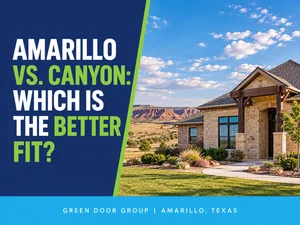
Amarillo vs. Canyon, Texas: Which Is the Better Fit for Your Home Search?
They sit less than 20 miles apart, share the same wide-open Panhandle sky, and are connected by one straight shot down I-27.
But buying a home in Amarillo and buying one in Canyon are not quite the same experience.
Amarillo offers a larger housing market, broader commercial footprint, multiple employment centers, and neighborhoods spanning nearly every era of the city’s growth. Canyon offers a more compact city layout shaped by a historic downtown, West Texas A&M University, and its position near Palo Duro Canyon.
Neither is universally “better.” The right choice depends on the property, location, commute, taxes, services, and day-to-day routine that fit your goals.Here is what homebuyers should compare before deciding where to begin their search.
Amarillo vs. Canyon at a Glance: Community Size
Amarillo: Larger regional city
Canyon: Smaller independent city
Housing selection
Amarillo: Broader range of ages, styles, prices, and locations
Canyon: More concentrated inventory within a smaller market
Commute
Amarillo: Access varies by neighborhood and destination
Canyon: Approximately 17–20 miles south of Amarillo
Higher education
Amarillo: Amarillo College and WTAMU’s Amarillo Center
Canyon: Main campus of West Texas A&M University
Recreation
Amarillo: Extensive city park system and regional attractions
Canyon: City parks, Palo Duro Creek Golf Course, and proximity to Palo Duro Canyon
Property taxes
Amarillo: Depend on the home’s exact taxing jurisdictions
Canyon: Depend on the home’s exact taxing jurisdictions
Home-search strategy
Amarillo: Compare neighborhoods and cross-city travel times
Canyon: Watch limited inventory closely and verify commute requirements
This comparison is only a starting point. Two houses with the same mailing city can differ significantly in construction, utility providers, school-district boundaries, taxing entities, restrictions, and travel time.
The Biggest Difference Is Scale
Amarillo is the region’s primary commercial and employment center. Its larger footprint gives buyers more territory to explore—and more variation from one part of the city to another.
A home near downtown Amarillo creates a different daily routine from one near the southwest edge of the city. The housing itself may also vary dramatically: early- and mid-century homes, established subdivisions, newer developments, townhomes, rural-edge properties, and new construction can all appear within the Amarillo market.
The City of Amarillo estimates its population at approximately 205,000 and maintains about 2,400 acres of parkland across 52 parks. That scale supports a wider selection of shopping, dining, healthcare, recreation, and professional services.
Canyon is a separate city with its own government and municipal services. Its footprint is much smaller, so the available housing inventory is naturally more concentrated. The city is also the Randall County seat and home to the main campus of West Texas A&M University.
WTAMU describes Canyon as a community of approximately 16,000 people. Its main campus covers 342 acres and enrolled more than 9,000 students in fall 2025. That university presence gives Canyon an identity distinct from simply being “south of Amarillo.”
How Different Is the Commute?
Canyon is approximately 17 to 20 miles south of Amarillo, depending on the points being measured. I-27 provides the primary connection between the two cities, and commuting between them is common.
However, the city names alone do not tell you what your actual commute will be.
A buyer working in south Amarillo may find Canyon more practical than expected. Someone traveling daily to northwest, northeast, or central Amarillo should calculate the entire route—not merely the distance from Canyon to the Amarillo city limit.
Before making an offer, test the drive:
During your normal morning departure time
During the evening return period
From the exact property, not a general ZIP code
To the locations you visit most often
In both ordinary and adverse weather conditions
Also consider construction, frontage-road access, school traffic, railroad crossings, and the time required to reach I-27 from the property.
A map can estimate mileage. It cannot tell you whether the drive works comfortably with your actual schedule.
Which Market Offers More Housing Choices?
Amarillo generally provides a larger and more varied pool of homes simply because it is the larger city.
Depending on current inventory, Amarillo buyers may encounter:
Historic and early-20th-century properties
Mid-century homes
Established subdivisions
Newer planned developments
Townhomes and patio homes
New construction
Properties with workshops or additional storage
Homes near the city’s rural edges
Acreage outside the city limits
Canyon’s smaller market may include:
Established homes near the city center
Properties near WTAMU
Newer residential development
New construction
Homes on larger lots
Properties outside the city limits
Rural and acreage options in surrounding areas
This does not mean one city always costs more or delivers more house for the money. Pricing changes with inventory, condition, location, land, improvements, financing conditions, and buyer demand.
A renovated older home in one market may compete with a newer but smaller property in the other. A home outside city limits may offer additional land but introduce different questions about water, septic systems, roads, utilities, emergency services, insurance, and deed restrictions.
The useful comparison is not, “Is Amarillo or Canyon cheaper?” It is: What combination of property, location, condition, monthly cost, and daily routine can I purchase within my budget?
Property Taxes Require an Address-by-Address Comparison
A city name does not determine a property’s entire tax bill.
Texas property taxes are affected by the specific taxing entities attached to the parcel. Those may include a city, county, school district, college district, hospital district, and other jurisdictions.
Amarillo also spans portions of both Potter and Randall counties, adding another reason buyers should never estimate taxes from the words “Amarillo” or “Canyon” alone.
Before making an offer, review:
The property’s current appraised value
Each taxing jurisdiction attached to the parcel
The current combined tax rate
Existing exemptions
Whether those exemptions will remain after the sale
How a future appraisal could affect the buyer’s payment
The lender’s estimated monthly escrow
The Potter-Randall Appraisal District provides property records and taxing-jurisdiction information for individual parcels.
Past tax bills are useful, but they are not a promise of what a new owner will pay.
What About Schools?
Public-school assignments should be treated as verifiable property information—not as a reason to label one community or neighborhood “better.”
Attendance zones and district boundaries do not always follow city limits or mailing addresses. Assignments can also change.
Buyers should:
Verify the school district for the exact property
Check current attendance-zone maps
Confirm assignments directly with the applicable district
Review objective information from the district and Texas Education Agency
Investigate any programs or services important to their household
Reconfirm the information before making a final housing decision
Green Door Group can help identify the resources available for a property, but buyers should evaluate those resources according to their own priorities.
City Services, Utilities, and Property Conditions
Amarillo and Canyon operate as separate municipalities. Buyers should compare the actual services connected to each property, especially when considering homes near or outside city limits.
Questions may include:
Who provides water and sewer service?
Is the property served by a private well or septic system?
Who provides trash collection?
Which utility companies serve the address?
Is the road publicly or privately maintained?
Are there deed restrictions or an owners association?
Are permits required for planned improvements?
What fire-protection territory serves the property?
Could the location affect insurance availability or cost?
These questions become especially important for rural, acreage, and city-edge properties. More land can be appealing, but it may also come with additional maintenance and infrastructure responsibilities.
Recreation and Day-to-Day Life
Amarillo’s larger scale provides a wider regional mix of parks, museums, entertainment venues, medical services, restaurants, retail, and organized recreation. The municipal park system encompasses approximately 2,400 acres and 52 parks.
Canyon maintains hundreds of acres of park and golf-course property, including Canyon Aqua Park and Palo Duro Creek Golf Course. The community also provides convenient access to West Texas A&M University and the Panhandle-Plains Historical Museum.
Palo Duro Canyon State Park lies east of Canyon and is one of the area’s defining destinations. Still, proximity to a recreational attraction should be considered alongside the commute, property itself, municipal services, and the places a buyer regularly needs to reach.
The best test is practical: spend time in both cities, drive the likely routes, and visit the areas that would become part of your normal week.
Who Should Consider Amarillo?
Amarillo may deserve closer consideration if your priorities include:
A wider selection of available homes
More neighborhood and architectural variety
Proximity to a particular Amarillo employer
Shorter access to specific healthcare, retail, or service locations
A broader range of new and established subdivisions
More options at a given moment in the market
These are not guarantees about every property. Amarillo is large enough that location within the city matters enormously.
Who Should Consider Canyon?
Canyon may deserve closer consideration if your priorities include:
A smaller municipal footprint
Proximity to West Texas A&M University
Access to Canyon’s downtown and city services
A practical commute to south Amarillo
Newer development or rural-edge options when available
Proximity to Palo Duro Canyon and Canyon-area recreation
Again, the address matters more than the generalization. A home’s condition, location, price, services, restrictions, and commute should drive the decision.
So, Is Amarillo or Canyon Better?
The honest answer is that neither wins automatically.
Choose Amarillo when a particular Amarillo property gives you the strongest combination of location, price, condition, services, and daily convenience.
Choose Canyon when a particular Canyon property better matches those same priorities.
And search both when you are not yet certain.
Because the most expensive mistake is not choosing the “wrong” city. It is becoming attached to a city name before comparing the individual properties and the full cost of owning them.
Frequently Asked Questions
How far is Canyon from Amarillo?
Canyon is approximately 17 to 20 miles south of Amarillo, depending on the starting and ending locations. I-27 is the principal route between the two cities. Buyers should test the complete commute from a prospective home during the hours they expect to travel.
Is Canyon a suburb of Amarillo?
Canyon is an independent city with its own government and municipal services. It is closely connected to Amarillo economically and geographically, but it is not merely an Amarillo neighborhood.
Is it cheaper to buy a home in Canyon or Amarillo?
There is no permanent answer. Prices depend on current inventory, property condition, location, lot size, construction, improvements, and demand. Buyers should compare current homes meeting the same requirements rather than relying on a citywide assumption.
Does Amarillo have more homes for sale than Canyon?
Amarillo generally has a larger housing market because it is considerably larger. However, the number and type of active listings in either city change continuously.
Can someone live in Canyon and work in Amarillo?
Yes. Commuting between Canyon and Amarillo is common. Whether it is practical for a particular buyer depends on the home’s location, the workplace, travel time, schedule, and personal preferences.
Are property taxes lower in Canyon or Amarillo?
Tax obligations must be calculated for the individual parcel. City, county, school-district, college-district, and other taxing jurisdictions may affect the total rate. Existing exemptions may not carry over to a buyer.
Can Green Door Group show homes in both cities?
Yes. Green Door Group assists buyers and sellers throughout Amarillo, Canyon, and surrounding Texas Panhandle communities.
Start With the Property—Not the Assumption
You do not have to choose Amarillo or Canyon before beginning your home search.
Green Door Group can help you compare active properties in both markets, examine the practical differences, and make an informed decision based on your budget and priorities.
Search Amarillo and Canyon homes or contact Green Door Group to begin.
Phone: (806) 318-8479
Green Door Group, LLC
Texas Real Estate Brokerage License #9012369-BB
Information is provided for general informational purposes and is subject to change. Buyers should independently verify property taxes, school assignments, utilities, municipal services, restrictions, commute times, measurements, and other information important to their purchase. Green Door Group supports equal housing opportunity and provides real estate services without regard to any characteristic protected by federal, state, or local law.